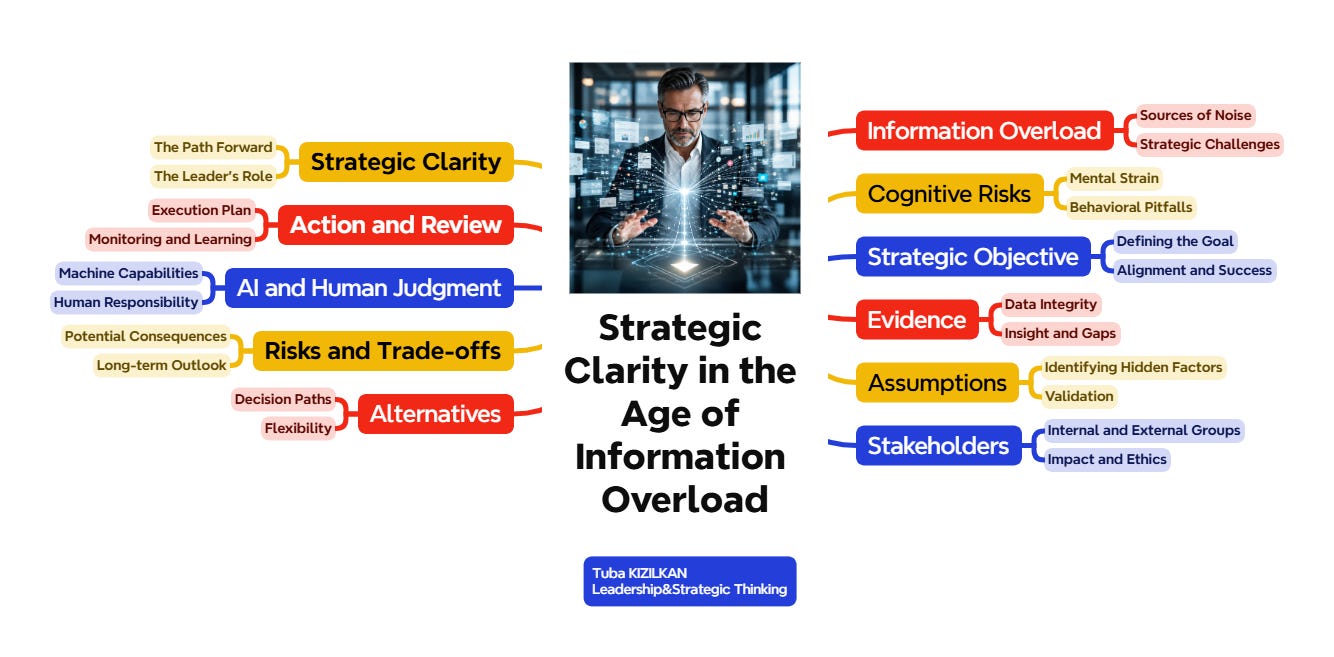
𝗦𝗧𝗥𝗔𝗧𝗘𝗚𝗜𝗖 𝗖𝗟𝗔𝗥𝗜𝗧𝗬 𝗜𝗡 𝗧𝗛𝗘 𝗔𝗚𝗘 𝗢𝗙 𝗜𝗡𝗙𝗢𝗥𝗠𝗔𝗧𝗜𝗢𝗡 𝗢𝗩𝗘𝗥𝗟𝗢𝗔𝗗
𝗛𝗼𝘄 𝗹𝗲𝗮𝗱𝗲𝗿𝘀 𝗰𝗮𝗻 𝘂𝘀𝗲 𝘃𝗶𝘀𝘂𝗮𝗹 𝘁𝗵𝗶𝗻𝗸𝗶𝗻𝗴, 𝗺𝗶𝗻𝗱 𝗺𝗮𝗽𝗽𝗶𝗻𝗴, 𝗮𝗻𝗱 𝗱𝗲𝗰𝗶𝘀𝗶𝗼𝗻 𝗮𝗿𝗰𝗵𝗶𝘁𝗲𝗰𝘁𝘂𝗿𝗲 𝘁𝗼 𝘁𝘂𝗿𝗻 𝗻𝗼𝗶𝘀𝗲 𝗶𝗻𝘁𝗼 𝗱𝗶𝗿𝗲𝗰𝘁𝗶𝗼𝗻


Leaders once struggled because they did not have enough information.
Today, many struggle because they have too much.
Dashboards update constantly.
Reports become longer.
Messages arrive faster.
Meetings multiply.
Artificial intelligence produces new summaries, recommendations, forecasts, and scenarios within seconds.
Yet despite this abundance, leaders do not always feel more certain.
In many cases, they feel less clear.
This is one of the central paradoxes of contemporary leadership:
More information can create less understanding.
The problem is not necessarily a lack of intelligence, data, technology, or expertise.
The problem is often the absence of structure.
Leaders may have access to hundreds of signals but no clear way to determine which ones matter most.
They may be surrounded by analysis while still lacking a well-defined decision.
They may receive ten recommendations without knowing which assumption each one depends on.
They may respond quickly because the environment feels urgent, even when the situation requires deeper thought.
In this context, strategic clarity has become one of the most valuable leadership capabilities.
Clarity is not the ability to simplify everything.
It is the ability to organize complexity without becoming trapped inside it.
𝗜𝗻𝗳𝗼𝗿𝗺𝗮𝘁𝗶𝗼𝗻 𝗶𝘀 𝗻𝗼𝘁 𝘁𝗵𝗲 𝘀𝗮𝗺𝗲 𝗮𝘀 𝗶𝗻𝘀𝗶𝗴𝗵𝘁
Organizations often assume that more data will automatically improve decisions.
But information does not become useful simply because it is available.
A dashboard may display twenty indicators, but it may not show which three are strategically significant.
A report may include detailed analysis, but it may not reveal what decision must be made.
An AI tool may generate several options, but it may not understand the organization’s culture, values, hidden tensions, or ethical boundaries.
Information becomes valuable only when leaders can place it in context.
They need to distinguish:
↳ evidence from assumption
↳ signal from noise
↳ urgency from importance
↳ short-term pressure from long-term consequence
↳ measurable activity from meaningful progress
Without this distinction, information overload creates a false sense of control.
The organization appears informed.
But being informed is not the same as being ready to decide.
𝗧𝗵𝗲 𝗿𝗲𝗮𝗹 𝗰𝗼𝘀𝘁 𝗼𝗳 𝗰𝗼𝗴𝗻𝗶𝘁𝗶𝘃𝗲 𝗼𝘃𝗲𝗿𝗹𝗼𝗮𝗱
Information overload affects more than productivity.
It affects judgment.
When leaders are exposed to too many inputs, attention becomes fragmented.
They move rapidly between messages, meetings, documents, and decisions.
This creates the appearance of activity, but it weakens deep thinking.
Under cognitive overload, leaders may:
↳ rely too heavily on the first available explanation
↳ focus on what is most visible rather than most important
↳ accept familiar assumptions without testing them
↳ postpone decisions because the analysis never feels complete
↳ make reactive choices to escape uncertainty
↳ confuse fast responses with strong leadership
Decision fatigue also changes the emotional tone of leadership.
Overloaded leaders may become impatient.
They may simplify complex issues too aggressively.
They may avoid difficult conversations.
They may delegate without sufficient clarity.
They may become more dependent on dashboards, external experts, or AI recommendations because their own attention is exhausted.
This is why attention should be treated as a strategic resource.
A leader’s ability to focus is not merely a personal productivity issue.
It influences the quality of organizational judgment.
𝗔𝗜 𝗶𝗻𝗰𝗿𝗲𝗮𝘀𝗲𝘀 𝗰𝗮𝗽𝗮𝗰𝗶𝘁𝘆—𝗮𝗻𝗱 𝗿𝗲𝘀𝗽𝗼𝗻𝘀𝗶𝗯𝗶𝗹𝗶𝘁𝘆
Artificial intelligence can support leaders in powerful ways.
It can detect patterns across large datasets.
It can summarize complex material.
It can generate scenarios.
It can compare alternatives.
It can help identify risks and opportunities.
But AI does not remove the need for human judgment.
It changes where judgment is required.
The leader must still ask:
What data shaped this recommendation?
What may be missing?
Which assumptions are embedded in the output?
Does this answer fit our context?
Who will be affected by the decision?
What ethical risks exist?
Who remains accountable if the recommendation is wrong?
AI can increase the number of available options.
But more options can also increase uncertainty.
This means leaders need stronger decision structures, not only faster tools.
The competitive advantage will not come from using the most AI.
It will come from using AI inside a disciplined process of human judgment.
𝗧𝗵𝗲 𝗽𝗿𝗼𝗯𝗹𝗲𝗺 𝗼𝗳 𝗽𝗼𝗼𝗿𝗹𝘆 𝗳𝗿𝗮𝗺𝗲𝗱 𝗱𝗲𝗰𝗶𝘀𝗶𝗼𝗻𝘀
Many organizations begin with data before clarifying the real decision.
They ask for another report.
They request more analysis.
They create another dashboard.
They schedule another meeting.
But the core question remains vague.
No amount of data can rescue a badly framed decision.
Before gathering more information, leaders need to ask:
What exactly must be decided?
Why does this decision matter?
What would success look like?
What are the consequences of delaying?
Which parts are reversible?
Which parts are difficult to reverse?
Who has authority?
Who carries the consequences?
A clearly framed decision narrows the information field.
It shows what evidence is relevant and what can be ignored.
It also prevents teams from confusing research with progress.
Sometimes the greatest source of overload is not too much information.
It is the absence of a clear question.
𝗙𝗿𝗼𝗺 𝗱𝗮𝘁𝗮 𝗰𝗼𝗹𝗹𝗲𝗰𝘁𝗶𝗼𝗻 𝘁𝗼 𝗱𝗲𝗰𝗶𝘀𝗶𝗼𝗻 𝗮𝗿𝗰𝗵𝗶𝘁𝗲𝗰𝘁𝘂𝗿𝗲
Decision architecture is the deliberate organization of the elements surrounding a decision.
It creates a visible structure for thinking.
A strong decision process should include:
↳ the strategic objective
↳ relevant evidence
↳ hidden assumptions
↳ key stakeholders
↳ available options
↳ risks and trade-offs
↳ ownership
↳ action and review
This structure reduces cognitive noise.
It helps leaders separate facts from interpretation.
It makes competing priorities visible.
It reveals where evidence is strong and where the organization is relying on belief.
It also improves collaboration because different stakeholders can examine the same decision structure.
This is especially important in complex organizations.
Without a shared structure, people may attend the same meeting while solving different versions of the problem.
One person focuses on cost.
Another focuses on customer experience.
Another focuses on risk.
Another focuses on reputation.
All perspectives may be valid.
But if they remain disconnected, discussion becomes fragmented.
Decision architecture helps bring them into one field.
𝗪𝗵𝘆 𝗺𝗶𝗻𝗱 𝗺𝗮𝗽𝗽𝗶𝗻𝗴 𝗺𝗮𝘁𝘁𝗲𝗿𝘀
Complex decisions do not develop in straight lines.
They contain relationships.
They contain tensions.
They contain feedback loops.
They contain uncertainty.
They contain human consequences that may not appear in a spreadsheet.
This is why mind mapping is so valuable.
A mind map places the core decision at the centre.
Around it, leaders can see the factors that shape the choice.
Evidence.
Assumptions.
Stakeholders.
Risks.
Alternatives.
Trade-offs.
Responsibilities.
Actions.
This visual structure reduces the burden on working memory.
It also reveals connections that may remain hidden in linear documents.
A risk may be connected to several stakeholders.
An assumption may influence more than one option.
A short-term benefit may create a long-term cost.
A stakeholder with little formal authority may experience the greatest impact.
These relationships are easier to see when the decision is mapped visually.
Mind mapping is therefore not only a creativity technique.
It is a strategic thinking tool.
It helps leaders externalize complexity.
It allows teams to inspect their thinking rather than merely defend their opinions.
𝗔 𝗽𝗿𝗮𝗰𝘁𝗶𝗰𝗮𝗹 𝗹𝗲𝗮𝗱𝗲𝗿𝘀𝗵𝗶𝗽 𝗱𝗲𝗰𝗶𝘀𝗶𝗼𝗻 𝗺𝗮𝗽
A practical decision map can begin with one central question.
Not a broad topic.
Not a department name.
Not a general challenge.
One clear decision.
For example:
Should we introduce AI-supported customer service within the next financial year?
From this centre, the leader can develop eight branches.
𝗦𝘁𝗿𝗮𝘁𝗲𝗴𝗶𝗰 𝗼𝗯𝗷𝗲𝗰𝘁𝗶𝘃𝗲
What value are we trying to create?
Is the goal cost reduction, service quality, speed, scalability, or customer satisfaction?
The objective must be explicit.
Otherwise, different stakeholders may evaluate the same option according to different standards.
𝗘𝘃𝗶𝗱𝗲𝗻𝗰𝗲
What do we actually know?
What is supported by data?
How recent is the evidence?
Who produced it?
What does it exclude?
Evidence should be separated from opinion and enthusiasm.
𝗔𝘀𝘀𝘂𝗺𝗽𝘁𝗶𝗼𝗻𝘀
What are we treating as true without sufficient proof?
Will customers accept the change?
Will employees adopt the system?
Will costs fall as quickly as expected?
Will integration be simple?
Assumptions become more useful when they are visible and testable.
𝗦𝘁𝗮𝗸𝗲𝗵𝗼𝗹𝗱𝗲𝗿𝘀
Who will be affected?
Customers.
Employees.
Managers.
Partners.
Regulators.
Communities.
Stakeholder mapping should identify not only power but also impact.
𝗔𝗹𝘁𝗲𝗿𝗻𝗮𝘁𝗶𝘃𝗲𝘀
What options exist beyond yes or no?
A pilot.
A phased rollout.
A partnership.
A smaller investment.
A redesigned process.
A delayed decision.
Good strategy avoids false either-or choices.
𝗥𝗶𝘀𝗸𝘀 𝗮𝗻𝗱 𝘁𝗿𝗮𝗱𝗲-𝗼𝗳𝗳𝘀
What value could be created?
What could be lost?
Efficiency may reduce flexibility.
Automation may reduce human contact.
Speed may weaken consultation.
Standardization may limit local adaptation.
Trade-offs should be made consciously.
𝗢𝘄𝗻𝗲𝗿𝘀𝗵𝗶𝗽
Who decides?
Who advises?
Who implements?
Who remains accountable?
Unclear authority causes repeated meetings, political delay, and weak execution.
𝗔𝗰𝘁𝗶𝗼𝗻 𝗮𝗻𝗱 𝗿𝗲𝘃𝗶𝗲𝘄
What happens next?
Who takes the first action?
What is the timeline?
What will success look like?
Which warning signals matter?
When will the decision be reviewed?
A decision should not disappear into a presentation.
It should become visible action.
𝗦𝗽𝗲𝗲𝗱 𝗶𝘀 𝗻𝗼𝘁 𝗮𝗹𝘄𝗮𝘆𝘀 𝗰𝗹𝗮𝗿𝗶𝘁𝘆
Contemporary leaders often work under pressure to act quickly.
Sometimes speed is essential.
But not every urgent feeling reflects an urgent decision.
The depth of analysis should match the consequences of the choice.
A reversible decision may justify experimentation.
A high-stakes, difficult-to-reverse decision requires greater care.
This is not indecision.
It is deliberate calm.
Deliberate calm means creating enough space to examine the problem before pressure begins to shape the answer.
It allows leaders to question assumptions, consider consequences, and resist emotional urgency.
The goal is not to slow the organization down.
The goal is to prevent the organization from moving quickly in the wrong direction.
𝗦𝘁𝗿𝗮𝘁𝗲𝗴𝗶𝗰 𝗰𝗹𝗮𝗿𝗶𝘁𝘆 𝗶𝘀 𝗮 𝗹𝗲𝗮𝗱𝗲𝗿𝘀𝗵𝗶𝗽 𝗱𝗶𝘀𝗰𝗶𝗽𝗹𝗶𝗻𝗲
Clarity is often discussed as a communication skill.
But clear communication begins with clear thinking.
Leaders must first understand:
What matters?
What is uncertain?
What evidence can be trusted?
What assumptions need testing?
Who will be affected?
What trade-offs must be accepted?
Only then can they communicate with confidence.
The strongest leaders will not be those who consume the most information.
They will be those who can create the clearest structure around it.
They will know when to use data.
When to challenge it.
When to use AI.
When to ask for human judgment.
When to move quickly.
When to pause.
Information will continue to expand.
Attention will remain limited.
This is why strategic clarity will become even more valuable.
More information is not the answer.
Better thinking architecture is.
What complex decision in your work would become clearer if you mapped its objective, evidence, assumptions, stakeholders, alternatives, risks, ownership, and next actions on a single page?