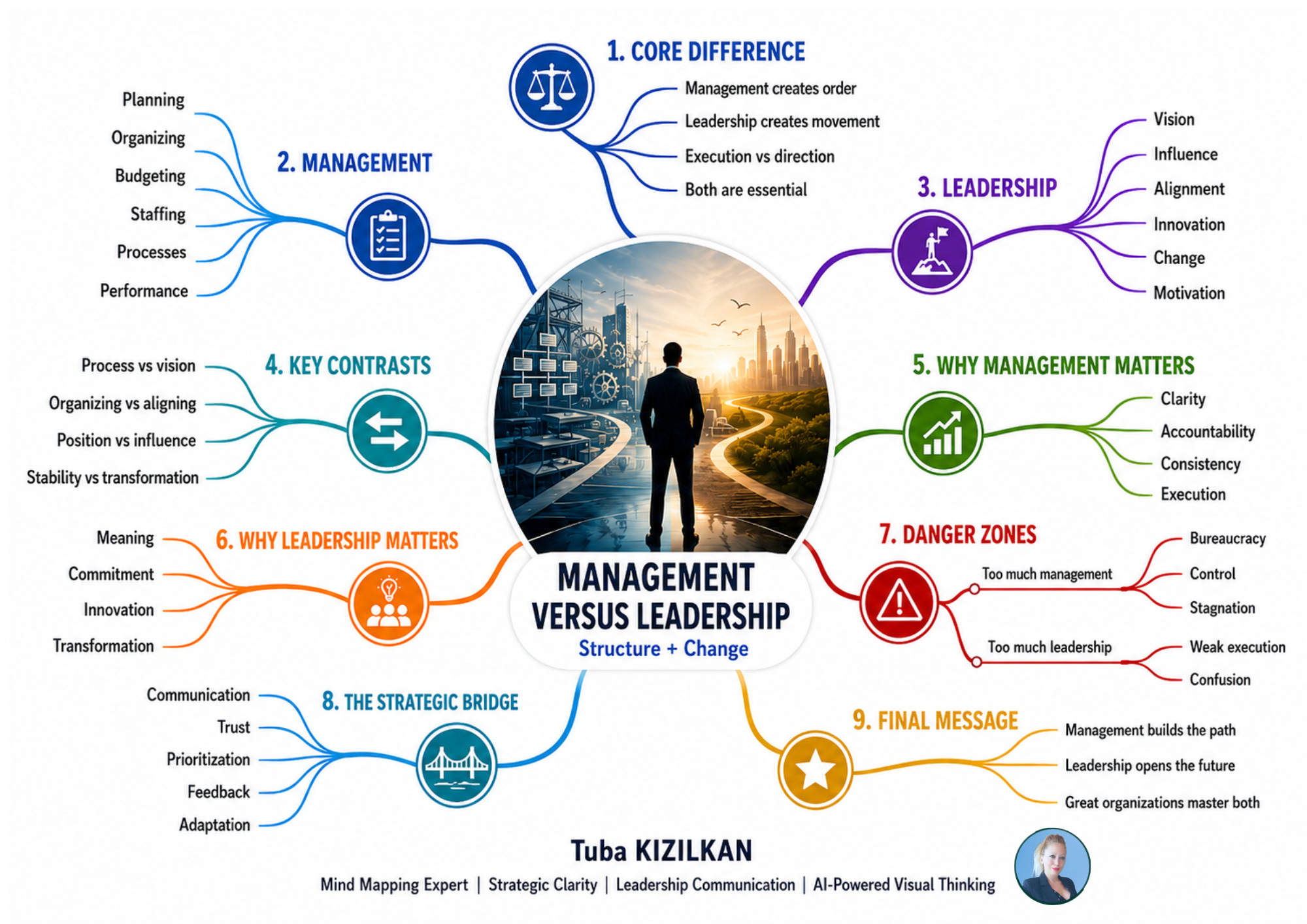
𝑳𝒆𝒂𝒅𝒆𝒓𝒔𝒉𝒊𝒑 𝒗𝒔. 𝑴𝒂𝒏𝒂𝒈𝒆𝒎𝒆𝒏𝒕: 𝑾𝒉𝒚 𝑶𝒓𝒈𝒂𝒏𝒊𝒛𝒂𝒕𝒊𝒐𝒏𝒔 𝑵𝒆𝒆𝒅 𝑩𝒐𝒕𝒉 𝑪𝒍𝒂𝒓𝒊𝒕𝒚 𝒂𝒏𝒅 𝑪𝒉𝒂𝒏𝒈𝒆

The terms leadership and management are often used as if they mean the same thing.
They do not.
They are connected, but they are not identical.
A manager may hold a formal position.
A leader may not.
A manager may organize the work.
A leader may shift the direction of the work.
A manager may protect stability.
A leader may challenge the existing pattern.
A manager may ask, “How can we execute this properly?”
A leader may ask, “Is this still the right direction?”
Both questions matter.
But they do not serve the same purpose.
In many organizations, confusion begins when leadership and management are treated as competing identities. One is presented as inspiring and visionary. The other is presented as administrative and ordinary.
This is a mistake.
Strong organizations need both.
Without management, vision remains abstract.
Without leadership, execution may become mechanical.
Without management, people may feel inspired but disorganized.
Without leadership, people may become efficient in the wrong direction.
The real question is not whether leadership is better than management.
The real question is this:
Can an organization create enough structure to perform today and enough leadership capacity to transform tomorrow?
𝗠𝗮𝗻𝗮𝗴𝗲𝗺𝗲𝗻𝘁 𝗰𝗿𝗲𝗮𝘁𝗲𝘀 𝗼𝗿𝗱𝗲𝗿
Management is the discipline of turning goals into coordinated action.
It is concerned with planning, organizing, allocating resources, building processes, measuring performance, solving operational problems, and ensuring that work gets done consistently.
Management protects reliability.
It gives people clarity about roles, deadlines, responsibilities, standards, and expected outcomes.
In practical terms, management answers questions such as:
What needs to be done?
Who is responsible?
By when?
With which resources?
According to which standards?
How will success be measured?
This is not a minor function.
Many organizations fail not because they lack ideas, but because they cannot execute them well.
A strategy that cannot be translated into daily work remains a presentation.
A vision without operational discipline becomes noise.
A team without clear management may feel energetic but scattered.
This is why management is not the enemy of leadership.
It is the infrastructure that allows leadership to become real.
Good management reduces confusion.
It protects time.
It prevents unnecessary chaos.
It turns ambition into structure.
𝗟𝗲𝗮𝗱𝗲𝗿𝘀𝗵𝗶𝗽 𝗰𝗿𝗲𝗮𝘁𝗲𝘀 𝗺𝗼𝘃𝗲𝗺𝗲𝗻𝘁
Leadership has a different centre of gravity.
Leadership is less about maintaining the current system and more about guiding people toward a meaningful future.
It is about vision, influence, alignment, courage, and change.
Leadership asks:
Where are we going?
Why does it matter?
What needs to change?
Who needs to believe in this direction?
What obstacles must be removed?
How can people be mobilized around a shared purpose?
Leadership is especially critical when the current way of working is no longer enough.
When markets shift.
When technology disrupts old processes.
When people lose motivation.
When organizations must transform.
When uncertainty becomes part of daily business.
In such moments, management alone is not enough.
Processes can preserve stability, but they cannot always create renewal.
Rules can protect order, but they cannot always generate commitment.
Plans can organize work, but they cannot always inspire people to move beyond habit.
Leadership creates emotional and strategic movement.
It helps people see a future that is not yet visible.
It gives meaning to change.
It turns uncertainty into direction.
𝗧𝗵𝗲 𝗱𝗮𝗻𝗴𝗲𝗿 𝗼𝗳 𝗼𝘃𝗲𝗿-𝗺𝗮𝗻𝗮𝗴𝗶𝗻𝗴
Organizations can become over-managed.
This does not mean they are too professional.
It means they become too attached to control, procedure, hierarchy, and predictability.
In over-managed environments, people may know exactly what to do, but not why it matters.
They may follow processes but stop questioning whether those processes still serve the organization.
They may avoid risk because the system rewards compliance more than intelligent initiative.
They may become efficient at maintaining yesterday’s logic.
This is dangerous in a changing world.
When management dominates without leadership, organizations can look stable on the surface while becoming strategically fragile underneath.
The meetings continue.
The reports are written.
The dashboards are updated.
The procedures are followed.
But the organization slowly loses imagination.
It stops sensing change early.
It stops developing new possibilities.
It stops asking difficult questions.
At that point, management is no longer creating order.
It is protecting stagnation.
𝗧𝗵𝗲 𝗱𝗮𝗻𝗴𝗲𝗿 𝗼𝗳 𝘂𝗻𝗱𝗲𝗿-𝗺𝗮𝗻𝗮𝗴𝗶𝗻𝗴
The opposite problem is also common.
Some organizations celebrate vision but neglect execution.
They speak beautifully about transformation, innovation, purpose, and the future, but their teams remain unclear about priorities, ownership, timelines, and practical steps.
This creates a different kind of damage.
People become inspired at first, then frustrated.
They hear the vision, but they do not see the structure.
They are asked to change, but they are not given the resources.
They are expected to deliver, but the process is vague.
They are told to be agile, but decision rights are unclear.
This is not leadership.
It is ambition without architecture.
Leadership without management can become theatrical.
It may sound impressive, but it does not build trust if people cannot see how the vision will be implemented.
A leader who cannot translate direction into execution risks becoming a source of confusion.
This is why effective leadership needs management discipline.
Vision needs structure.
Inspiration needs coordination.
Change needs operational design.
𝗧𝗵𝗲 𝗯𝗲𝘀𝘁 𝗹𝗲𝗮𝗱𝗲𝗿𝘀 𝗰𝗮𝗻 𝗺𝗼𝘃𝗲 𝗯𝗲𝘁𝘄𝗲𝗲𝗻 𝗯𝗼𝘁𝗵
The strongest professionals are not trapped in one identity.
They know when to manage and when to lead.
They can create order, but they do not worship the status quo.
They can inspire people, but they do not ignore execution.
They can work with systems, but they do not forget the human side of change.
They can build processes, but they also challenge outdated assumptions.
This balance is becoming increasingly important in modern organizations.
Today’s leaders and managers operate in environments shaped by digital transformation, artificial intelligence, hybrid work, global uncertainty, cultural complexity, and rapid market shifts.
In this context, management and leadership must work together.
Management provides stability.
Leadership provides direction.
Management protects execution.
Leadership protects meaning.
Management reduces chaos.
Leadership prevents stagnation.
Management asks whether the work is being done correctly.
Leadership asks whether the right work is being done at all.
Both questions are essential.
𝗧𝗵𝗲 𝗵𝘂𝗺𝗮𝗻 𝗱𝗶𝗺𝗲𝗻𝘀𝗶𝗼𝗻
The deepest intersection between leadership and management is people.
Both require the ability to understand human behaviour.
A manager who does not understand people may create efficient systems that nobody wants to follow.
A leader who does not understand people may create a vision that fails to gain trust.
People do not commit only because a plan exists.
They commit when they understand the purpose, trust the direction, and feel respected within the process.
This is where emotional intelligence becomes essential.
Leaders and managers both need to listen.
They need to communicate clearly.
They need to understand motivation.
They need to manage conflict.
They need to create psychological safety.
They need to help people perform without reducing them to tasks.
The difference is often in emphasis.
Management coordinates people around work.
Leadership aligns people around meaning.
But in real organizational life, both are needed at the same time.
𝗪𝗵𝗲𝗿𝗲 𝗺𝗶𝗻𝗱 𝗺𝗮𝗽𝗽𝗶𝗻𝗴 𝗰𝗮𝗻 𝗵𝗲𝗹𝗽
One reason leadership and management are confused is that both involve complexity.
There are goals, people, emotions, systems, risks, deadlines, resources, and changing expectations.
Linear thinking often separates these elements too strongly.
A mind map can help make the relationship between leadership and management visible.
At the centre, we can place the core challenge:
How do we move from vision to execution?
Then two major branches can emerge:
Leadership
Management
Under leadership, we may map:
Vision
Change
Influence
Alignment
Innovation
Purpose
Culture
Motivation
Under management, we may map:
Planning
Processes
Resources
Roles
Timelines
Performance
Risk
Execution
Then comes the most important part:
the bridge between them.
This bridge includes:
Communication
Decision-making
Trust
Prioritization
Accountability
Learning
Feedback
Adaptation
This is where real organizational effectiveness happens.
Not in leadership alone.
Not in management alone.
But in the intelligent connection between direction and delivery.
Mind mapping is useful because it helps professionals see that leadership and management are not opposing forces.
They are complementary energies.
One opens the future.
The other builds the path.
One mobilizes people.
The other coordinates action.
One challenges assumptions.
The other stabilizes execution.
A healthy organization needs both.
𝗔 𝗽𝗿𝗮𝗰𝘁𝗶𝗰𝗮𝗹 𝗿𝗲𝗳𝗹𝗲𝗰𝘁𝗶𝗼𝗻 𝗳𝗼𝗿 𝗹𝗲𝗮𝗱𝗲𝗿𝘀 𝗮𝗻𝗱 𝗺𝗮𝗻𝗮𝗴𝗲𝗿𝘀
If you are in a leadership or management role, ask yourself:
Am I creating enough clarity for people to execute?
Am I creating enough meaning for people to care?
Am I protecting stability where it is needed?
Am I challenging the status quo where it is necessary?
Am I managing processes without losing people?
Am I inspiring people without neglecting structure?
Am I measuring performance without killing initiative?
Am I encouraging change without creating chaos?
These questions reveal the real maturity of leadership.
Because modern organizations do not need leaders who only inspire.
They do not need managers who only control.
They need professionals who can hold both dimensions with intelligence.
𝗙𝗶𝗻𝗮𝗹 𝘁𝗵𝗼𝘂𝗴𝗵𝘁
Leadership and management are not enemies.
They are two different responsibilities inside the same organizational reality.
Management keeps the organization reliable.
Leadership keeps the organization alive.
Management turns goals into action.
Leadership turns possibility into direction.
Management helps people deliver.
Leadership helps people believe the delivery matters.
The future will not belong to organizations that choose one over the other.
It will belong to organizations that understand the difference and build the bridge.
Because when leadership and management work together, vision becomes executable.
And execution becomes meaningful.