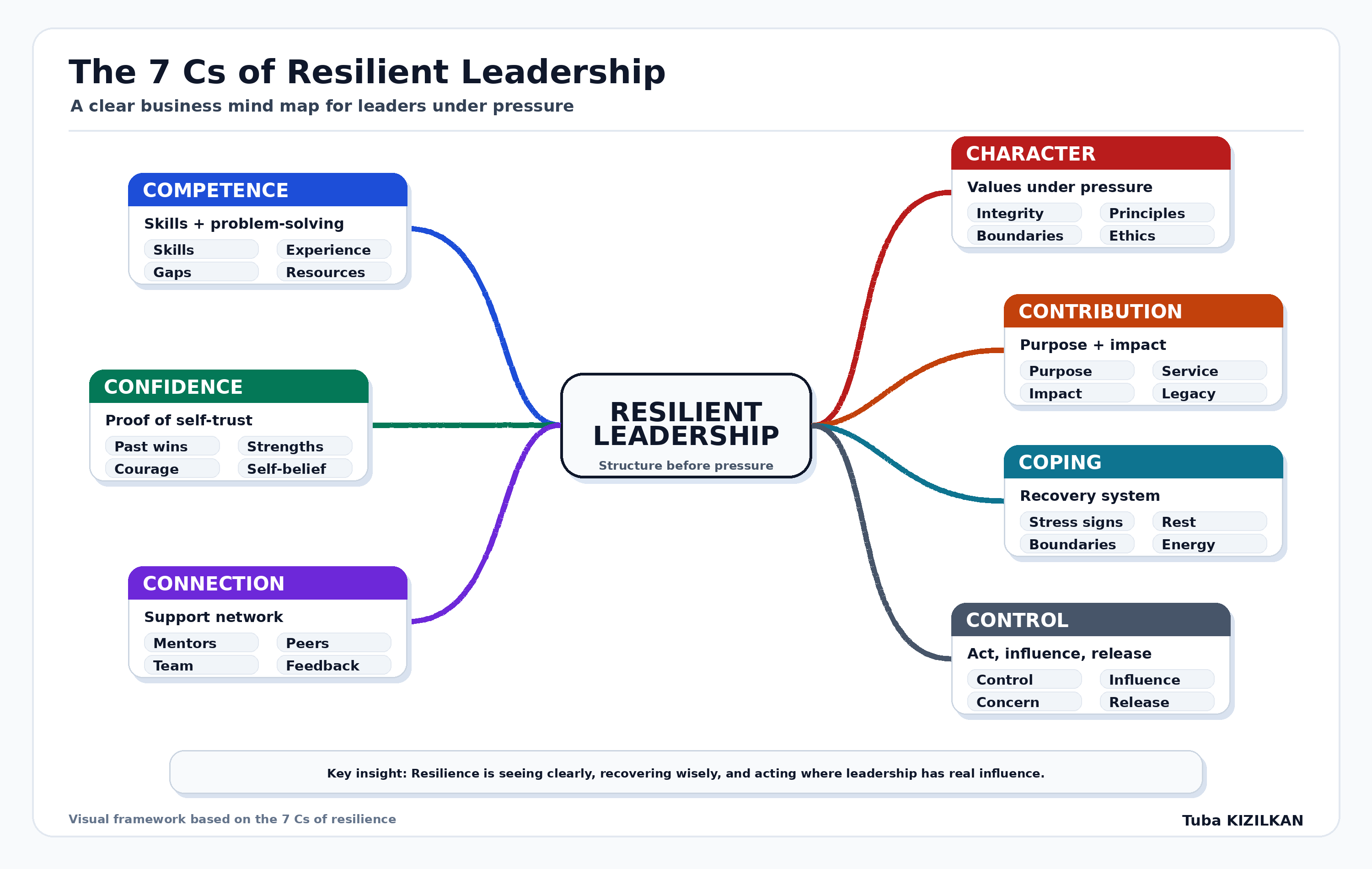
𝑻𝒉𝒆 7 𝑪𝒔 𝒐𝒇 𝑹𝒆𝒔𝒊𝒍𝒊𝒆𝒏𝒕 𝑳𝒆𝒂𝒅𝒆𝒓𝒔𝒉𝒊𝒑: 𝑯𝒐𝒘 𝑴𝒊𝒏𝒅 𝑴𝒂𝒑𝒑𝒊𝒏𝒈 𝑻𝒖𝒓𝒏𝒔 𝑷𝒓𝒆𝒔𝒔𝒖𝒓𝒆 𝑰𝒏𝒕𝒐 𝑪𝒍𝒂𝒓𝒊𝒕𝒚

Leadership is often tested long before a formal crisis appears.
It is tested in small moments:
when a decision must be made without full information,
when a team is anxious,
when priorities collide,
when emotional pressure rises,
when the leader must stay clear while everyone else is looking for direction.
In such moments, resilience is not a motivational slogan.
It is a leadership system.
Many people describe resilience as the ability to bounce back. But for leaders, this definition is too small.
A leader does not simply bounce back privately. A leader must recover while still communicating, deciding, listening, prioritising, and protecting the emotional climate of the team.
This is why resilient leadership requires more than toughness.
It requires structure.
The 7 Cs of resilience offer a powerful framework for this structure:
Competence
Confidence
Connection
Character
Contribution
Coping
Control
Each of these areas strengthens a different part of the leader’s inner and outer support system. Together, they show that resilience is not only about coping with stress. It is about developing the capacity to think clearly, act wisely, and remain human under pressure.
But here is the challenge.
Under pressure, even good frameworks can remain abstract.
A leader may know their values but forget to use them.
They may have support but hesitate to ask for it.
They may have experience but lose confidence.
They may try to control what is outside their control.
They may keep working while ignoring the early signs of exhaustion.
This is where mind mapping becomes powerful.
Mind mapping turns resilience from an invisible idea into a visible leadership practice.
It helps leaders externalise pressure, organise complexity, and see their resources on one page.
A resilience mind map does not merely look beautiful.
It creates a thinking space.
It allows leaders to ask better questions before the pressure becomes destructive.
Let us look at the 7 Cs through the lens of mind mapping.
1/ 𝗖𝗼𝗺𝗽𝗲𝘁𝗲𝗻𝗰𝗲: What can I already do?
Competence is the leader’s awareness of skills, experience, knowledge, and problem-solving ability.
During pressure, leaders often forget what they already know because the urgency of the situation becomes louder than their memory of previous success.
A competence map helps restore perspective.
Branches may include:
Skills
Experience
Knowledge gaps
Resources
Problem-solving ability
People who can help
This is not about pretending to know everything.
It is about seeing clearly what is already available and what still needs to be developed.
A resilient leader can say:
I do not have every answer, but I know what I know, I can identify what I do not know, and I can find the right support.
That is competence under pressure.
2/ 𝗖𝗼𝗻𝗳𝗶𝗱𝗲𝗻𝗰𝗲: What evidence supports my self-trust?
Confidence is often misunderstood.
It is not loudness.
It is not performance.
It is not pretending to be fearless.
Real confidence is the quiet belief that difficulty can be faced without losing oneself.
Under pressure, the mind often produces fear-based questions:
What if I fail?
What if I disappoint people?
What if I am not ready?
What if I make the wrong decision?
A confidence mind map can interrupt this spiral by making evidence visible.
Branches may include:
Past wins
Strengths
Feedback
Challenges already survived
Moments of courage
Small steps outside the comfort zone
This matters because stress often makes people forget their own proof.
A mind map reminds the leader:
I have handled difficult things before.
I have learned.
I have grown.
I can take the next responsible step.
3/ 𝗖𝗼𝗻𝗻𝗲𝗰𝘁𝗶𝗼𝗻: Who helps me think clearly?
Resilience is not individual heroism.
Many leaders try to carry everything alone because they believe strength means self-sufficiency.
But isolated leaders often become fragile leaders.
Connection is one of the most important parts of resilience because people need reliable relationships when pressure increases.
A connection map helps leaders identify their support system.
Branches may include:
Mentors
Peers
Team members
Professional communities
Trusted advisors
Family
Friends
People who give honest feedback
The deeper question is not only:
Who do I know?
The better question is:
Who helps me think better?
Who helps me stay grounded?
Who can challenge me without increasing panic?
Who needs my support too?
Resilient leadership is relational.
It grows through trust, belonging, and honest conversation.
4/ 𝗖𝗵𝗮𝗿𝗮𝗰𝘁𝗲𝗿: What do I stand for when pressure rises?
Character is about values, principles, integrity, and ethical direction.
Pressure does not create character.
It reveals whether character has already been clarified.
When leaders have not defined their values, they may make decisions based on fear, approval, urgency, or image protection.
A character map helps leaders clarify their non-negotiables before difficult moments arrive.
Branches may include:
Core values
Leadership principles
Ethical boundaries
Non-negotiables
Behaviours I will not normalise
Standards I want to model
This map becomes a moral compass.
Because under pressure, the easiest decision is not always the right decision.
The fastest option is not always the wisest one.
The popular choice is not always the ethical one.
A resilient leader asks:
What kind of leader do I want to be when the situation becomes difficult?
This question protects trust.
And trust is one of the most valuable leadership assets.
5/ 𝗖𝗼𝗻𝘁𝗿𝗶𝗯𝘂𝘁𝗶𝗼𝗻: Why does this work matter?
Contribution connects leadership to purpose.
Leaders need more than tasks, targets, meetings, and performance indicators.
They need meaning.
A contribution map helps leaders reconnect with the larger reason behind their effort.
Branches may include:
Purpose
People I serve
Impact
Team growth
Customer value
Positive change
Legacy
This matters because pressure without meaning becomes exhaustion.
But pressure connected to purpose can become disciplined commitment.
A leader who understands contribution can ask:
Who benefits from my clarity?
What impact do I want to create?
How does this decision serve something larger than my comfort?
Resilience becomes stronger when effort is connected to meaning.
6/ 𝗖𝗼𝗽𝗶𝗻𝗴: How do I recover before burnout arrives?
Coping is not weakness.
It is energy management.
A leader who cannot regulate stress will eventually transfer stress.
It may appear as impatience, control, silence, emotional distance, poor listening, or reactive decisions.
A coping map helps leaders identify stress patterns and recovery strategies.
Branches may include:
Stress signals
Recovery habits
Sleep
Movement
Boundaries
Reflection
Supportive conversations
Digital pauses
Delegation
Warning signs of overload
This is practical leadership hygiene.
A resilient leader does not wait for collapse before taking recovery seriously.
They build recovery into their leadership system.
Because exhausted leaders may still be productive, but they are rarely fully perceptive.
7/ 𝗖𝗼𝗻𝘁𝗿𝗼𝗹: What can I act on, influence, or release?
Control is one of the most important resilience skills for leaders.
Many leaders waste energy trying to control what they can only influence.
Others suffer because they emotionally carry things they cannot change at all.
A control map creates clarity through three branches:
Circle of control
Circle of influence
Circle of concern
Under control, the leader maps direct actions:
my communication
my preparation
my priorities
my behaviour
my boundaries
my response
Under influence, the leader maps areas that require collaboration:
team culture
stakeholder alignment
decision buy-in
organisational change
Under concern, the leader maps what matters but cannot be directly controlled:
market uncertainty
other people’s reactions
past decisions
external crises
institutional limitations
This distinction is powerful.
It helps leaders stop wasting energy in the wrong place.
Act where action is possible.
Influence where influence is realistic.
Release what cannot be carried.
That is not passivity.
That is disciplined leadership.
𝗪𝗵𝘆 𝗺𝗶𝗻𝗱 𝗺𝗮𝗽𝗽𝗶𝗻𝗴 𝗺𝗮𝗸𝗲𝘀 𝗿𝗲𝘀𝗶𝗹𝗶𝗲𝗻𝗰𝗲 𝗽𝗿𝗮𝗰𝘁𝗶𝗰𝗮𝗹
The 7 Cs are powerful as a framework.
But when they are mind mapped, they become usable.
A mind map helps leaders see:
where they are strong
where they are vulnerable
who supports them
what they stand for
what restores their energy
what gives their work meaning
what they can control
what they must release
This is the value of visual thinking in leadership.
It does not remove complexity.
It makes complexity visible.
It does not eliminate uncertainty.
It helps leaders organise their response to uncertainty.
It does not create emotional perfection.
It gives leaders a structured way back to clarity.
For me, this is where resilient leadership and mind mapping meet.
Resilience gives the leader inner strength.
Mind mapping gives that strength visible structure.
And when pressure rises, visible structure can become the difference between reaction and wisdom.
The future of leadership will not only belong to people who know more.
It will belong to leaders who can see patterns earlier, recover faster, connect more wisely, and act with clarity when pressure is high.
That is why every leader should have a resilience map before the crisis arrives.
Not because leaders should avoid pressure.
But because they should not enter pressure without structure.