𝗧𝗛𝗘 𝗦𝗧𝗥𝗔𝗧𝗘𝗚𝗬 𝗠𝗔𝗣
𝗛𝗼𝘄 𝗺𝗶𝗻𝗱 𝗺𝗮𝗽𝗽𝗶𝗻𝗴 𝗰𝗮𝗻 𝗵𝗲𝗹𝗽 𝗹𝗲𝗮𝗱𝗲𝗿𝘀 𝗿𝗲𝗶𝗻𝘃𝗲𝗻𝘁 𝗯𝘂𝘀𝗶𝗻𝗲𝘀𝘀 𝗺𝗼𝗱𝗲𝗹𝘀, 𝗼𝗿𝗴𝗮𝗻𝗶𝘇𝗲 𝗔𝗜-𝗱𝗿𝗶𝘃𝗲𝗻 𝗰𝗼𝗺𝗽𝗹𝗲𝘅𝗶𝘁𝘆, 𝗮𝗻𝗱 𝘁𝘂𝗿𝗻 𝘀𝘁𝗿𝗮𝘁𝗲𝗴𝘆

Business strategy used to feel more stable.
A company could define its market, understand its customers, design an offer, build operations, and improve the model gradually.
That world has not disappeared completely.
But it is no longer enough.
Today, business models are being pressured from several directions at once.
Artificial intelligence is changing how work is performed.
Digital platforms are reshaping how value reaches customers.
Customers expect faster, more personalized, and more transparent experiences.
Sustainability, regulation, trust, and data protection are no longer side issues.
Skills become outdated faster.
Teams are overloaded with dashboards, meetings, tools, reports, and digital communication.
And leaders are being asked to reinvent organizations while still delivering short-term performance.
This creates one of the central strategic challenges of our time:
How can leaders see the whole business model clearly enough to change it intelligently?
For me, one practical answer is mind mapping.
Not mind mapping as decoration.
Not mind mapping as colourful note-taking.
But mind mapping as strategic architecture.
A strategy map helps leaders make the business model visible.
It shows how value is created, delivered, captured, supported, governed, and renewed.
In a complex business environment, that visibility is not a luxury.
It is a leadership capability.
𝗪𝗛𝗬 𝗦𝗧𝗥𝗔𝗧𝗘𝗚𝗬 𝗡𝗘𝗘𝗗𝗦 𝗔 𝗩𝗜𝗦𝗨𝗔𝗟 𝗦𝗬𝗦𝗧𝗘𝗠
Most strategic problems are not linear.
A pricing decision affects customer perception.
A customer experience problem may come from internal process friction.
An AI investment may fail because the workflow was never redesigned.
A talent problem may actually be a capability visibility problem.
A sustainability decision may affect cost, reputation, regulation, and innovation at the same time.
A growth opportunity may depend on partners, platforms, data, skills, and trust.
Traditional strategy documents often separate these elements.
Mind mapping reconnects them.
It allows leaders to place one strategic question at the centre and then map the surrounding system:
What value are we creating?
For whom?
Through which channels?
With which capabilities?
With which partners?
At what cost?
With what risks?
With which technology?
Measured by which outcomes?
This is important because strategy is not simply choosing a direction.
Strategy is understanding how different choices interact.
A mind map helps leaders see those interactions.
It turns complexity into a visible field of decisions.
𝗧𝗛𝗘 𝗕𝗨𝗦𝗜𝗡𝗘𝗦𝗦 𝗠𝗢𝗗𝗘𝗟 𝗜𝗦 𝗔 𝗟𝗜𝗩𝗜𝗡𝗚 𝗦𝗬𝗦𝗧𝗘𝗠
Many leaders use business model frameworks to describe customers, value propositions, channels, resources, partners, costs, and revenues.
That structure is useful.
But in today’s environment, it is not enough to fill in the boxes.
Leaders must understand how the boxes influence one another.
If customer expectations change, the value proposition may need to change.
If the value proposition changes, capabilities must change.
If capabilities change, roles and skills must change.
If AI enters the workflow, governance must change.
If delivery becomes more digital, trust and customer experience must be redesigned.
If partners become more important, the company must think as part of an ecosystem, not only as an isolated organization.
A business model is not a static diagram.
It is a network of choices.
That is exactly why mind mapping is powerful.
It does not only show components.
It shows movement, dependency, tension, and possibility.
𝗙𝗥𝗢𝗠 𝗕𝗨𝗦𝗜𝗡𝗘𝗦𝗦 𝗣𝗟𝗔𝗡 𝗧𝗢 𝗦𝗧𝗥𝗔𝗧𝗘𝗚𝗬 𝗠𝗔𝗣
A traditional business plan often answers:
What will we do?
A strategy map asks:
How must the whole system work for this strategy to become real?
This distinction matters.
Many strategies fail not because the idea is weak, but because the system behind the idea is unclear.
The offer is clear, but the customer journey is not.
The vision is strong, but the operating model is weak.
The product is attractive, but the revenue logic does not match how customers experience value.
The AI tool is powerful, but employees do not trust it.
The company talks about innovation, but rewards only short-term efficiency.
The leadership team wants transformation, but the organization is designed for maintenance.
A strategy map helps reveal these contradictions early.
It moves leaders from ambition to architecture.
𝗦𝗘𝗩𝗘𝗡 𝗕𝗥𝗔𝗡𝗖𝗛𝗘𝗦 𝗢𝗙 𝗔 𝗠𝗢𝗗𝗘𝗥𝗡 𝗕𝗨𝗦𝗜𝗡𝗘𝗦𝗦 𝗦𝗧𝗥𝗔𝗧𝗘𝗚𝗬 𝗠𝗔𝗣
A strong business strategy mind map can begin with one central question:
How do we create, deliver, and capture value in a changing environment?
From that centre, seven strategic branches can guide the thinking.
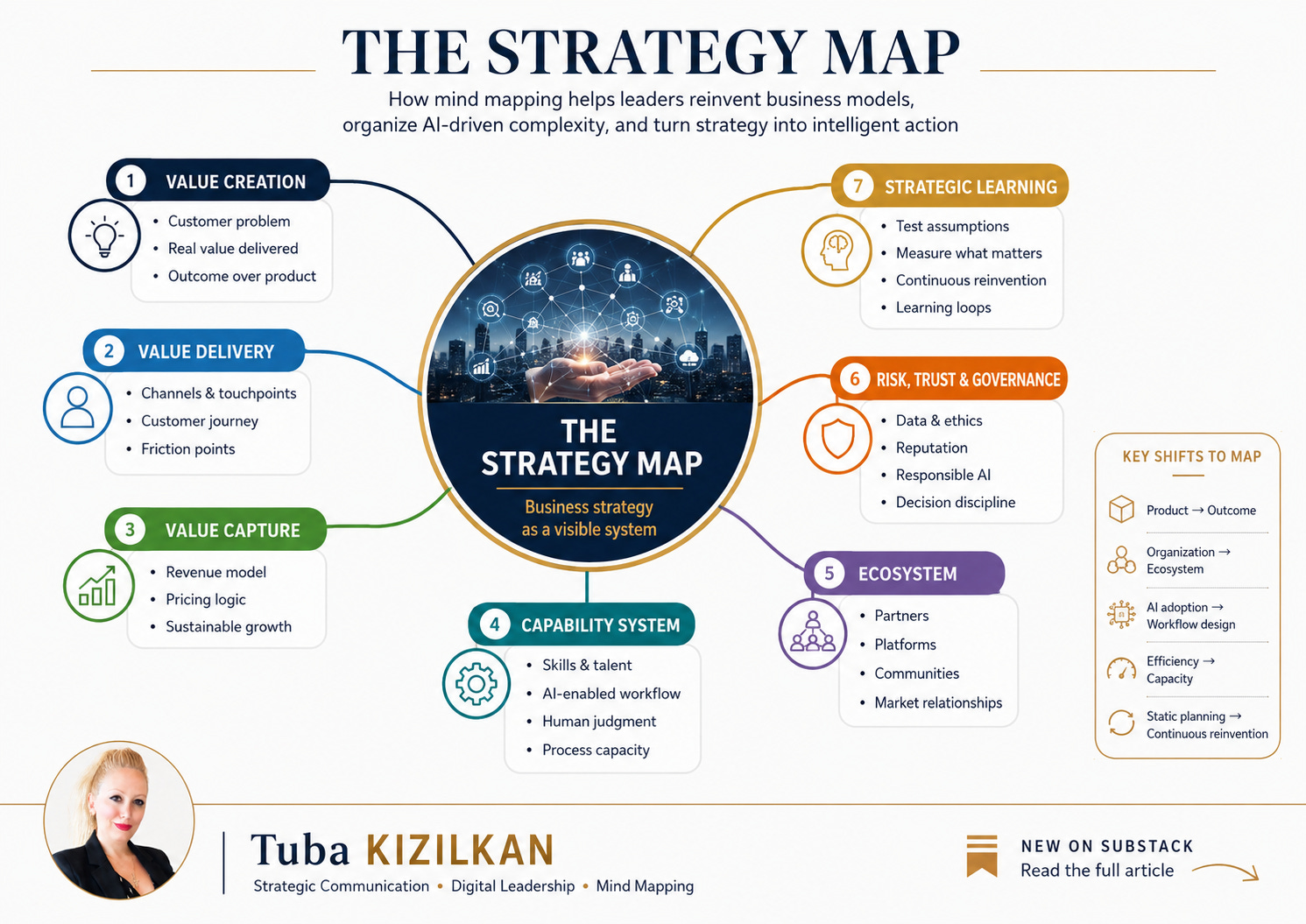
𝗕𝗥𝗔𝗡𝗖𝗛 𝟭: 𝗩𝗔𝗟𝗨𝗘 𝗖𝗥𝗘𝗔𝗧𝗜𝗢𝗡
What problem are we solving?
For whom?
Why does it matter now?
What outcome does the customer truly value?
This is where many businesses need more clarity.
They may describe what they sell, but not what value they create.
Customers rarely buy a product only because it exists.
They buy progress, confidence, clarity, convenience, access, relief, speed, status, or transformation.
A strategy map helps leaders separate the offer from the deeper value behind it.
That distinction is essential.
A company that understands its real value can adapt its business model more intelligently.
𝗕𝗥𝗔𝗡𝗖𝗛 𝟮: 𝗩𝗔𝗟𝗨𝗘 𝗗𝗘𝗟𝗜𝗩𝗘𝗥𝗬
How does value reach the customer?
Through which channels?
Through which platforms?
Through which touchpoints?
Through which partners?
In contemporary business, delivery can be as important as the offer itself.
A strong product with a poor customer journey loses power.
A valuable service with too much friction becomes exhausting.
A good idea with weak distribution remains invisible.
Mind mapping helps leaders see the full journey and identify where clarity, trust, or momentum breaks down.
It also helps teams understand that customer experience is not created only at the front end.
It is shaped by internal processes, technology, communication, culture, and decision speed.
𝗕𝗥𝗔𝗡𝗖𝗛 𝟯: 𝗩𝗔𝗟𝗨𝗘 𝗖𝗔𝗣𝗧𝗨𝗥𝗘
How does the business earn sustainably?
What is the pricing logic?
What is the revenue model?
Does the way we capture value match the way customers experience value?
Modern business models increasingly move beyond simple one-time transactions.
Companies explore subscriptions, platforms, freemium models, outcome-based models, ecosystem models, AI-enhanced services, licensing, communities, and data-enabled value.
The strategic question is not only:
How do we make money?
The better question is:
Is our revenue model aligned with the value customers believe they are receiving?
When value creation and value capture are misaligned, growth becomes fragile.
A strategy map makes this misalignment visible.
𝗕𝗥𝗔𝗡𝗖𝗛 𝟰: 𝗖𝗔𝗣𝗔𝗕𝗜𝗟𝗜𝗧𝗬 𝗦𝗬𝗦𝗧𝗘𝗠
What capabilities must we build?
What skills do we already have?
What skills are missing?
Where can AI support the work?
Where is human judgment essential?
Where are teams overloaded?
Where are processes blocking performance?
A company may have a strong strategy but lack the capability system to execute it.
This is especially important in the age of AI.
AI adoption is not only a technology decision.
It is a capability decision.
People need skills, confidence, redesigned workflows, governance, and time to learn.
Without these conditions, AI becomes another layer of complexity rather than a source of strategic value.
A strategy map helps leaders see whether the capability system is strong enough to support the ambition.
It can also reveal hidden talent, transferable skills, and unnecessary work that consumes capacity.
𝗕𝗥𝗔𝗡𝗖𝗛 𝟱: 𝗘𝗖𝗢𝗦𝗬𝗦𝗧𝗘𝗠
Who do we need around us?
Which partners increase value?
Which platforms shape access?
Which communities influence trust?
Which regulations shape the market?
Which competitors could become collaborators?
Business is becoming more ecosystem-driven.
Companies no longer compete only as individual organizations.
They compete through networks, partnerships, platforms, data relationships, supply chains, communities, and knowledge ecosystems.
A strategy map helps leaders see where they are too isolated.
Sometimes the next stage of growth does not come from doing more internally.
It comes from building better external relationships.
𝗕𝗥𝗔𝗡𝗖𝗛 𝟲: 𝗥𝗜𝗦𝗞, 𝗧𝗥𝗨𝗦𝗧, 𝗔𝗡𝗗 𝗚𝗢𝗩𝗘𝗥𝗡𝗔𝗡𝗖𝗘
What could damage trust?
What risks are we ignoring?
What ethical questions exist?
How do we protect data?
How do we use AI responsibly?
What are the reputational consequences?
Where might short-term efficiency create long-term harm?
Modern strategy cannot separate growth from trust.
A business model may be profitable and still fragile if customers, employees, regulators, or partners do not trust it.
This is especially relevant when AI, data, automation, personalization, or platform dependency are involved.
Mind mapping helps leaders make invisible risks visible.
It creates space to ask uncomfortable but necessary questions before those questions become crises.
𝗕𝗥𝗔𝗡𝗖𝗛 𝟳: 𝗦𝗧𝗥𝗔𝗧𝗘𝗚𝗜𝗖 𝗟𝗘𝗔𝗥𝗡𝗜𝗡𝗚
What are we learning?
What assumptions need testing?
What evidence do we need?
What should we measure?
What should we stop doing?
What should we improve?
What should we experiment with next?
The strongest business models are not only designed.
They learn.
They adapt through feedback, customer signals, operational data, experiments, reflection, and strategic review.
A mind map can become a living strategy tool.
It can be revisited monthly or quarterly to update assumptions, identify changes, test risks, and reveal new opportunities.
This is where mind mapping supports agility.
Not by making strategy vague.
But by making strategic learning visible.
𝗙𝗜𝗩𝗘 𝗕𝗨𝗦𝗜𝗡𝗘𝗦𝗦 𝗠𝗢𝗗𝗘𝗟 𝗦𝗛𝗜𝗙𝗧𝗦 𝗟𝗘𝗔𝗗𝗘𝗥𝗦 𝗦𝗛𝗢𝗨𝗟𝗗 𝗠𝗔𝗣
When I look at contemporary business strategy, five shifts stand out.
𝗙𝗜𝗥𝗦𝗧: 𝗙𝗥𝗢𝗠 𝗣𝗥𝗢𝗗𝗨𝗖𝗧 𝗧𝗢 𝗢𝗨𝗧𝗖𝗢𝗠𝗘
Customers increasingly care less about what a company offers and more about the result it helps them achieve.
This means leaders must map the outcome behind the product.
What progress does the customer want?
What pain is being reduced?
What confidence is being increased?
What transformation is being enabled?
𝗦𝗘𝗖𝗢𝗡𝗗: 𝗙𝗥𝗢𝗠 𝗢𝗥𝗚𝗔𝗡𝗜𝗭𝗔𝗧𝗜𝗢𝗡 𝗧𝗢 𝗘𝗖𝗢𝗦𝗬𝗦𝗧𝗘𝗠
Value is often created through partners, platforms, communities, data flows, and networks.
Leaders must therefore map not only internal resources but also external dependencies and opportunities.
The strategic unit is no longer always the company alone.
It may be the ecosystem around the company.
𝗧𝗛𝗜𝗥𝗗: 𝗙𝗥𝗢𝗠 𝗔𝗜 𝗔𝗗𝗢𝗣𝗧𝗜𝗢𝗡 𝗧𝗢 𝗔𝗜-𝗘𝗡𝗔𝗕𝗟𝗘𝗗 𝗪𝗢𝗥𝗞𝗙𝗟𝗢𝗪 𝗗𝗘𝗦𝗜𝗚𝗡
The question is not simply whether a company uses AI.
The question is whether AI is integrated into the way value is created, delivered, measured, and governed.
This requires workflow redesign, human oversight, decision rights, trust, and accountability.
AI should not be added to broken processes and expected to create transformation.
The process itself must often be redesigned.
𝗙𝗢𝗨𝗥𝗧𝗛: 𝗙𝗥𝗢𝗠 𝗘𝗙𝗙𝗜𝗖𝗜𝗘𝗡𝗖𝗬 𝗧𝗢 𝗖𝗔𝗣𝗔𝗖𝗜𝗧𝗬
Many organizations try to do more by adding more tools, more meetings, more dashboards, and more tasks.
But sometimes the strategic question is not how to add more.
It is how to remove what prevents people from doing meaningful work.
Capacity is not only about headcount.
It is also about attention, energy, decision clarity, and better ways of working.
A strategy map can show where organizational capacity is being wasted.
𝗙𝗜𝗙𝗧𝗛: 𝗙𝗥𝗢𝗠 𝗦𝗧𝗔𝗧𝗜𝗖 𝗣𝗟𝗔𝗡𝗡𝗜𝗡𝗚 𝗧𝗢 𝗖𝗢𝗡𝗧𝗜𝗡𝗨𝗢𝗨𝗦 𝗥𝗘𝗜𝗡𝗩𝗘𝗡𝗧𝗜𝗢𝗡
A business model should not be treated as something completed once.
It should be reviewed as markets, technology, customer expectations, regulations, and capabilities change.
Reinvention is no longer a rare crisis response.
It is becoming a strategic habit.
Mind mapping can support this habit by making assumptions, dependencies, and learning visible.
𝗪𝗛𝗬 𝗧𝗛𝗜𝗦 𝗠𝗔𝗧𝗧𝗘𝗥𝗦 𝗙𝗢𝗥 𝗟𝗘𝗔𝗗𝗘𝗥𝗦
Leaders do not fail only because they lack strategy.
They often fail because strategy remains invisible to the people who must act on it.
A strategy hidden in a long document is not enough.
A strategy reduced to slogans is not enough.
A strategy fragmented across departments is not enough.
People need to see how their work connects to the whole.
They need to understand where value comes from, where it goes, and what must change.
A mind map can help leaders create that shared picture.
It turns strategy into a visible conversation.
It allows teams to ask:
Where are we clear?
Where are we guessing?
Where are we overloaded?
Where are we dependent?
Where are we underestimating risk?
Where are we missing opportunity?
Where should we focus next?
This is why mind mapping belongs in strategy rooms, leadership workshops, startup planning, consulting conversations, and business model reviews.
Not as decoration.
As decision architecture.
𝗙𝗜𝗡𝗔𝗟 𝗧𝗛𝗢𝗨𝗚𝗛𝗧
The future of business will not reward companies that only collect more information.
It will reward companies that can organize complexity into intelligent action.
AI will continue to produce more analysis.
Markets will continue to change.
Customers will continue to expect more.
Teams will continue to face pressure.
The leader’s task is not to make complexity disappear.
The task is to make it visible enough to work with.
That is the power of a strategy map.
It helps leaders see the business model as a living system.
It connects value creation, value delivery, value capture, capabilities, ecosystems, risks, and learning.
It turns strategy from a document into a thinking process.
And in a world where business models must keep evolving, that may be one of the most practical advantages a leader can build.
𝗞𝗧𝗔 𝗤𝗨𝗘𝗦𝗧𝗜𝗢𝗡
Which part of your business model would become clearer if you mapped it visually today: value creation, delivery, capture, capabilities, ecosystem, risk, or learning?
𝗥𝗘𝗙𝗘𝗥𝗘𝗡𝗖𝗘𝗦
PwC. 28th Annual Global CEO Survey 2025.
Deloitte. 2025 Global Human Capital Trends Report.
World Economic Forum. The Future of Jobs Report 2025.
McKinsey & Company. The State of AI: How Organizations Are Rewiring to Capture Value, 2025.
Bohnsack, R., & de Wet, M. AI is the Strategy: From Agentic AI to Autonomous Business Models onto Strategy in the Age of AI, 2025.